
Landlords: Your AST Templates Must Be Updated Before the New APT Rules Begin
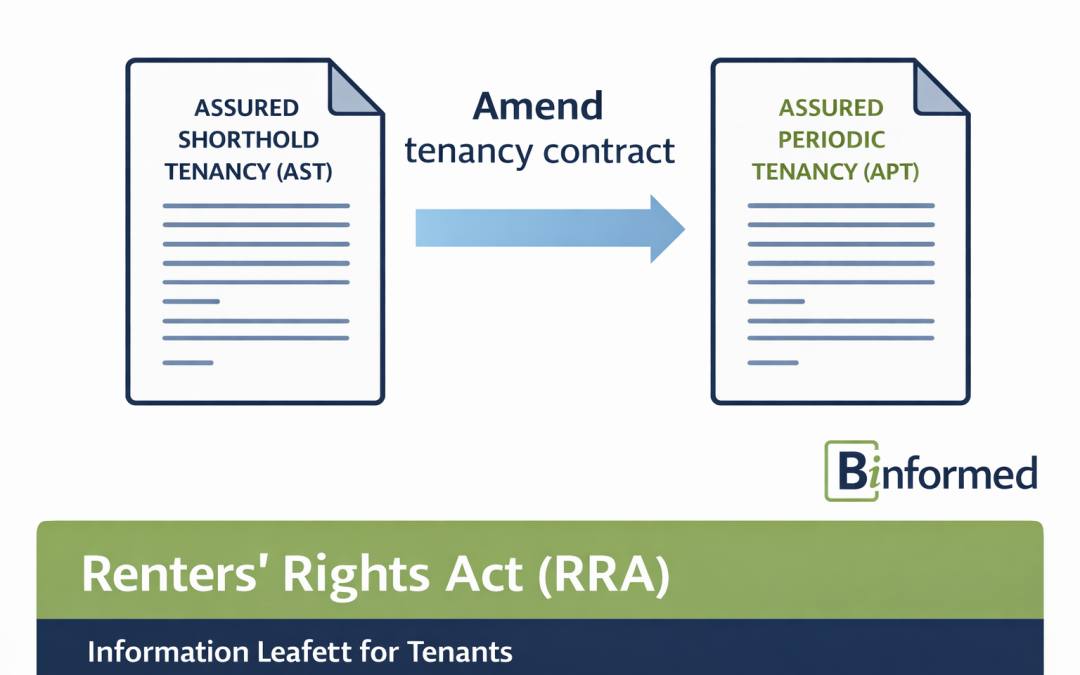
From 1 May 2026, the Renters’ Rights Act (RRA) replaces Assured Shorthold Tenancies (ASTs) with Assured Periodic Tenancies (APTs) for all new tenancies. Even more importantly:
⭐ All existing ASTs automatically convert into APTs on the first rent day after 1 May 2026.
This means landlords and agents must urgently review their legacy AST templates to ensure they do not contain clauses that will become unlawful under the new regime.
Below is a clear breakdown of the clauses that must be removed to remain compliant.
⭐ 1. Fixed Term Clauses — Must Be Deleted
Any clause that:
- Creates a fixed term (“This tenancy is for 12 months…”)
- States a start and end date
- Requires renewal or re‑signing
- Suggests the tenancy ends automatically
❗ Why?
APTs must be rolling periodic from day one. Fixed terms are no longer lawful after 1 May 2026.
⭐ 2. Break Clauses — Remove All of Them
This includes:
- Landlord break clauses
- Tenant break clauses
- Mutual break clauses
❗ Why?
Break clauses contradict the statutory structure of an APT.
⭐ 3. Section 21 / No‑Fault Eviction Clauses — Remove Entirely
Delete any clause that:
- Mentions Section 21
- Refers to “no‑fault eviction”
- States the landlord can give two months’ notice
- Suggests the tenancy ends at the end of a fixed term
❗ Why?
Section 21 is abolished from 1 May 2026.
⭐ 4. Rent Increase Clauses Outside Section 13 — Remove
Delete clauses that:
- Allow rent increases “at any time”
- Allow increases more than once per year
- Tie increases to RPI/CPI automatically
- Allow contractual rent review notices
❗ Why?
All rent increases must follow Section 13, once every 12 months.
⭐ 5. Upfront Rent Clauses Over 1 Month — Remove
Delete clauses that:
- Require more than one month’s rent in advance
- Allow multiple months’ rent after the tenancy starts
- Include “advance rent schedules” (e.g., 3–6 months upfront)
❗ Why?
The new rules cap required upfront rent at 1 month.
⭐ 6. Clauses Requiring Pet Insurance — Remove
Delete clauses that:
- Require tenants to buy pet insurance
- Require reimbursement of landlord insurance
- Require any compulsory pet‑related insurance
❗ Why?
The government removed this proposal — compulsory pet insurance is unlawful.
⭐ 7. Blanket Pet Bans — Remove or Rewrite
Delete clauses that:
- State “No pets under any circumstances”
- Ban pets without a request process
- Prevent tenants from making a statutory pet request
❗ Why?
Tenants now have a legal right to request a pet, and landlords must respond within 28 days.
⭐ 8. Clauses Restricting Tenant Notice — Remove
Delete clauses that:
- Require more than 2 months’ notice
- Prevent notice during the first X months
- Tie notice to fixed terms
- Require notice to expire on a specific date
❗ Why?
Tenants may give 2 months’ notice at any time.
⭐ 9. Clauses Allowing Possession for Sale or Moving In — Remove
Delete clauses that:
- Allow the landlord to end the tenancy to sell
- Allow the landlord to end the tenancy to move in
- Refer to “landlord’s intention to sell” as a contractual right
❗ Why?
These are now statutory Section 8 grounds (Grounds 1A and 1B). They cannot be contractual.
⭐ 10. Renewal Fees or Contractual Renewal Clauses — Remove
Delete clauses that:
- Require the tenant to sign a new agreement
- Charge a renewal fee
- State the tenancy ends unless renewed
❗ Why?
APTs roll automatically, and renewal fees are prohibited.
⭐ 11. Clauses That Conflict With the New PRS Database — Remove
Delete clauses that:
- Refer to “local authority registration”
- Treat licensing as the only compliance requirement
- Omit the landlord’s duty to register on the PRS Database
❗ Why?
The PRS Database becomes mandatory from 2027.
⭐ Do Landlords Need to Issue New Tenancy Agreements on 1 May 2026?
✔ No — provided you already have a written AST in place before 1 May.
Your existing written AST will automatically convert into an APT on the first rent day after 1 May 2026.
You only need a new agreement if:
- The tenancy begins on or after 1 May 2026, or
- There is currently no written AST at all
This is a crucial point for landlord reassurance.
⭐ What Landlords Should Do Now
✔ Review all AST templates
Remove the clauses listed above.
✔ Check all active tenancies
Ensure a written AST exists before 1 May.
✔ Update your processes for new APTs
All new tenancies from 1 May must be APT‑compliant.
✔ Train staff and update systems
The new rules require consistent compliance.
⭐ Need Help Updating Your Tenancy Agreements?
Binformed provides:
- Updated APT‑compliant tenancy templates
- Training for landlords and agents
- Compliance audits
- RRA transition support
- Guidance on the PRS Database
Visit www.Binformed.co.uk or email [email protected] for expert help.