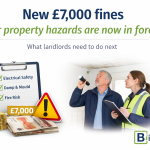
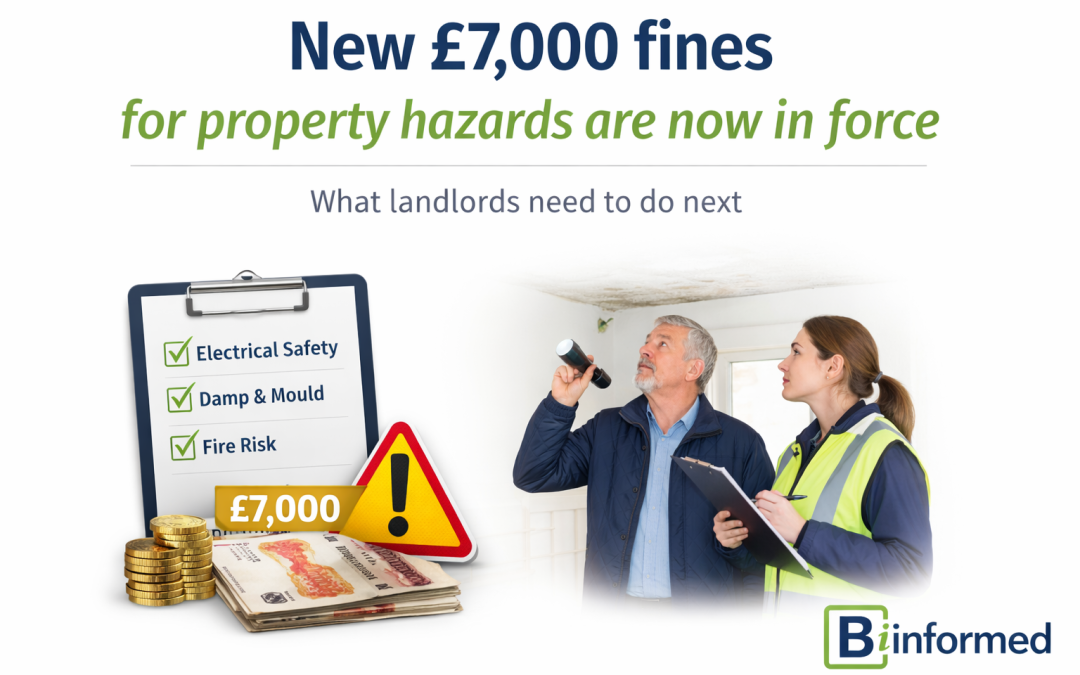
From 22 June 2026, councils can issue on-the-spot civil penalties to landlords with unresolved Category 1 hazards. Here’s what the change means, which properties are at risk, and how to protect yourself.
What’s at stake
- Councils can now issue fines of up to £7,000 per hazard without going to court.
- The fines apply to 21 Category 1 hazards — the most serious level under the HHSRS.
- An estimated 1 in 10 private rented homes has at least one qualifying hazard.
- The updated Housing Health and Safety Rating System comes into force on 23 June, making inspections faster and simpler.
- With section 21 evictions scrapped, tenants face no risk of retaliatory eviction for reporting you to the council.
What has changed?
Under the Renters’ Rights Act, councils in England gained a new enforcement tool on 22 June 2026: the power to issue civil financial penalties of up to £7,000 directly to landlords where a Category 1 hazard is found in a privately rented home.
Previously, councils had to pursue serious cases through the courts — a process that was slow, expensive, and rarely used. This new penalty sits alongside existing powers (improvement notices, emergency works, cost recovery) and gives councils a much faster route to enforcement. The Housing Secretary has written directly to mayors and councils urging them to use every power available.
Important: Where a council identifies a Category 1 hazard, it has a legal duty to take enforcement action. This isn’t discretionary.
Which hazards trigger the fine?
The £7,000 penalty applies to hazards at the most serious Category 1 level, assessed under the Housing Health and Safety Rating System. The 21 covered hazards include:
Damp and mould · Excess cold · Excess heat · Electrical hazards · Fire risks · Falls on stairs or between levels · Structural collapse · Unsafe layouts · and others assessed as presenting a serious risk to occupants.
A hazard only reaches Category 1 when its assessed risk to the occupant is above a set threshold — so not every instance of damp, for example, will qualify. But where it does, the council is obliged to act.
The HHSRS has been updated — and that matters
The Housing Health and Safety Rating System, the framework inspectors use to assess your property, is being updated for the first time in 20 years. The new version comes into force on 23 June 2026. It reduces the number of hazard categories from 29 to 21 by merging those that are statistically similar — making inspections faster to complete and easier for councils to act on.
Crucially, new guidance and illustrated case studies will be published to help inspectors apply the system more consistently. That means less variability between councils — and less room for ambiguity about whether a hazard crosses the Category 1 threshold.
Why tenants are more likely to report problems now
The abolition of section 21 “no-fault” evictions changes the dynamic significantly. In the past, some tenants may have tolerated poor conditions rather than risk being asked to leave. That deterrent is gone. Tenants can now report hazards to their council’s housing enforcement team without any risk of retaliatory eviction — and advocacy groups are actively encouraging them to do so.
The practical upshot: if there’s a serious hazard in your property, the likelihood that it gets reported — and that the council acts on it — is higher than it has ever been.
What you should do now
Proactive landlords have nothing to fear. These rules are aimed at those who ignore hazards and fail to act. If you maintain your properties properly and respond quickly to tenant concerns, you are very unlikely to face a fine.
- Walk your properties and check for the most common Category 1 hazards — damp, mould, heating, electrics, and fire safety in particular.
- If you receive a repair request from a tenant, acknowledge it promptly in writing and give a realistic timeline for fixing it.
- Familiarise yourself with the updated HHSRS (in force 23 June) — the new guidance will be published at gov.uk and is worth reading.
- If a council inspector visits, cooperate fully. Contesting a notice you cannot defend only delays resolution and may increase costs.
- Keep records of all repair work: dates, contractors, invoices. Evidence that you acted in good faith matters.
What if you receive a fine?
The £7,000 figure is a maximum — councils have discretion on the amount. Enforcement guidance published alongside the new rules sets out the factors councils should consider. If you receive a penalty notice, you’ll have the opportunity to make representations before it is finalised. The fine sits alongside, not instead of, improvement notices and other orders — so you may be required to carry out repairs as well as pay a penalty.
Source: Ministry of Housing, Communities and Local Government press release, 21 June 2026